Etiquetas

different guide (295) differentguidevalencia (294) Valencia (266) differentguide (248) different (225) español (147) english (141) curiosidades (125) alternativo (123) alternative (120) curiosities (120) agenda (92) diary (66) Túria (58) historia (41) history (39) tourism (36) turismo (36) musica (30) music (28) conciertos (27) concerts (25) pueblos (24) towns (23) españa (19) day (18) dia (18) tradiciones (18) tour (17) mediterranean sea (16) comer (15) spain (15) moverse (14) paella (14) tradition (14) Mediterraneo (13) to eat (12) Albufera (11) tapa (11) gigs (10) playa (10) Tomatina (9) transportes (8) DEMONSTRATION (7) MANIFESTACION (7) bici (7) enviroment (7) guide (7) how to move (7) medio ambiente (7) restaurant (7) restaurante (6) tapas (6) aventura (5) bike (5) divertido (5) adventure (4) emergencias (4) funny (4) humor (4) emergency (3) ruta (3)
Mostrando entradas con la etiqueta history. Mostrar todas las entradas

miércoles, 2 de enero de 2013

FUNDRAISING FOR HOUSE OF CHARITY IN THE MUSEUM L'IBER (toy soldier's museum) January 2, 2013


During today into hours from 11 to 14 and from 16 to 19 hours all proceeds L'Iber Museum (Considered the largest museum of historical miniatures figures in the world ) will go to the House of Charity in Valencia .

The museum features an exhibition of 95,000 figures that grows daily with over 1,000,000 in stock figures and restoration.

The entrance fee is 5 Euros. 3 Euros reduced admission for seniors, youth card, unemployed and others.

The museum is located at Calle Caballeros 20-22 (in the Carmen district of Valencia).


picture of the facade of the museum l'iber taken from their website

lunes, 31 de diciembre de 2012

WHY DO WE EAT 12 GRAPES FOR NEW YEAR EVE?


The Spanish tradition dictates that you have to eat 12 grapes with the 12 chimes of new year.
We do not know since when exactly started this tradition, for which there are different theories that originated at different dates.

What is known is that during the nineteenth century the Spanish bourgeoisie celebrated the New Year with champagne grapes and possibly a custom imported from France.

In 1896 a group of people from Madrid decided to meet in the Puerta del Sol in Madrid (where currently meeting the largest number of people in Spain to eat them and where was broadcast by radio and from 1962 by Spanish Television), to satirize the bourgeois custom  to start the year with grapes and champagne, when it is believed the popular origin.


This tradition began massively in Spain in 1909. This was due to a surplus the harvest of production in in the region of Alicante (also in Murcia and Almería), in which farmers were able to make a good marketing strategy, popularizing the bourgeois habit of eating 12 grapes of luck to celebrate the New Year.

Tradition says that whoever eats 12 grapes to the beat of the chimes will enter the new year with luck.

There is no consensus about why grapes are 12, while a majority defends it by 12 strokes, there are theories that say formerly ate one for each month of the year.


Although Spain most emblematic site, is Madrid's Puerta del Sol, although people in each city, usually gather in the town square of their locality (or some other point with an iconic clock tower).

In Valencia traditionally are eaten in the town hall square.


picture of the 12 grapes of luck & cava


lunes, 24 de diciembre de 2012

SPAIN AND THE RELIGIOUS FESTIVALS


Something curious in Spain, is that except Labor Day (May 1), the Women's Day (March 8, which is not a holiday) and maybe some more that I can not remember, has managed to associate all these holidays to religious celebrations:


October 12 Columbus Day is celebrated La Our Lady of Pilar (the Pilarica) patron of the Armed Forces.

October 9th day of the Valencian Community is celebrated on St. Dionis, patron of Valencian lovers .

Spring Break, which are matched to Christian Easter.

December 6, The Spanish Constitution Day celebrated with the day of the Immaculate Conception (December 8) forming the Purisima holidays.

Las Fallas is celebrated on St. Joseph's Day.

And each village festivities are related to the patron saint or the Virgin of every Spanish town.

Without mentioning the purely religious holidays such as Christmas, etc ...

Although it is true that religions (including Christian majority in Spain) have always moved dates or created directly to appropriate some celebration or pagan celebrations of other faiths and win converts to their faith.

Spain has been a country with a long and established tradition Christian. Including the dictator Francisco Franco who ruled for 40 years last century, which had deep Christian convictions (although it does not prove with his frequent torture and murders, because violate the Commandments of God. But neither is nothing new, because  in the name of any God, and have been committed the worst atrocities still were committed in the world) as well as great links he had with this church.


image taken from imagenes.com

viernes, 14 de diciembre de 2012

MOVIES FROM THE EARLY 20TH CENTURY IN THE FILM LIBRARY


The film library file has restored several silent films of the early 1900s that "premiering" on December 14.
The short films narrates the daily life of Valencia (religious processions, weddings, etc ...).
Each film is accompanied by live piano music.
The projection on the 14th is at 20 hours in the room Luis Garcia Berlanga. Located in the town hall square in Valencia number 17 (in the Rialto building).
With these projections wants to introduce the work of conservation and restoration of cultural heritage film by the film library. Besides being an interesting look at the life of early last century.


image taken from the IVAC website

viernes, 7 de diciembre de 2012

DECEMBER 6 SPANISH CONSTITUTION DAY


On December 6th is a holiday in Spain, in which we celebrate the approval of the present constitution
This was approved by the Spanish in a referendum 6 December 1978.
Establishing a parliamentary monarchy (in which men and women can vote from the age of 18) that recognizes the king as head of state (although their functions are merely representative and symbolic, since its decisions must be countersigned by the Prime Minister , President of the Congress or a Minister.

Collect the fundamental liberal principle  of the separation of powers (hypothetical, because in practice the three powers are represented by the same political parties) with bicameralism, Congress of Deputies and Senate that share the legislative power, with a preponderance of Congress .
Besides this the judicial power whose highest body is the Constitutional Court.

During this day, is makes a open day at the Madrid Congress and various institutional and political acts.


photo of the flag-raising in Madrid taken from the website of RTVE 
(public spanish tv)


BRIEF OVERVIEW OF SPANISH CONSTITUTIONALISM

The first Spanish Constitution could be said that was the Statute of Bayonne in 1808, although its limited application and the historical context (it was a Spanish Constitutional Charter enacted by Joseph Bonaparte, brother of Napoleon Bonaparte and proclaimed king of Spain after the French occupation, this was written in Bayonne inspired by French constitutional model).
Although the principle of the constitutionalism Spanish, comes with the constitution of 1812 (known as La Pepa, presumably because it was approved the day of San José) promulgated  by the Spanish Parliament on March 19 in Cadiz (Andalusia). that had an extensive and rigid text  establishing the sovereignty in the nation (and not in king), had a noticeable character reactionary to the French occupation and was the most liberal of the time.

Although it was repealed two years later in Valencia (on May 4, 1814), after that there were several unsuccessful attempts to retrieve it.
Finally we arrived at the current Spanish constitution ratified in a referendum on December 6, 1978.
The promulgation of this constitution ended the Spanish transition,  process that began with the death of the dictator Franco on November 20, 1975.


Photo of a copy of the Constitution of 1978 set forth in the Spanish Congress, taken from Wikipedia

lunes, 19 de noviembre de 2012

THE OTHER SIDE OF THE CITY OF ARTS AND SCIENCES (part 3)


The permanent exhibitions are often damaged, their generally educational value is limited:
The science museum has very little of its space for exhibitions, which are generally poor, trying to save with participatory areas (which generally do not work), and workshops for children who are more focused on entertaining than to teach.
The Agora, is permanently closed.
L'Oceanografic is more a water park to see dolphins doing tricks to an aquarium that teaches biology.
L'Umbracle, is only operates as a private club.
The Palau de les Arts (the opera) serves more as a place for conventions, private parties and various presentations, which as opera.
I think in this circus of dubious culturalism, L'Hemisferic is only saves from this poor cultural offerings with its range of 3D planetarium and documentary film.

As generally in Spain there is a certain contempt for energy savings, in which light is wasted (in general lighting, and the citizenship of their workers little because walking around the office areas are lights and computers on, without anyone being used) as if it were free and from inexhaustible sources.


In addition to large pools and artificial rivers treated with products harmful to the environment, to be always "nice", also favor a large evaporation of water must be replenished constantly, in a country and a region that suffers especially severe droughts, and where fresh water is sparse. And while approving municipal regulations to limit the use of private pools of Valencia (which are quite rare in the city) have the luxury of wasting it in artificial landscapes, terribly managed and poorly designed.
To which we must add the great air conditioning consumption as is needed in this large buildings  and with so much wasted space (which increases energy waste and contributes to climate change).


It should be added that the Valencian government, says that the city of arts and sciences is more visited than the "Alhambra" in Granada, which if it were true (which I doubt), has the problem that most people visit the city of science alone outside, so it is not profitable.
The only current profitability of the city of arts and sciences, is the fact that is rented for events and publicity spots.


report of "salvados" Spanish television program of La Sexta on the Spanish cultural bubble. Sorry, only in Spanish


picture from the city of arts &ciencies made by me


THE OTHER SIDE OF THE CITY OF ARTS AND SCIENCES (part 2)

Because conceived on paper their forms, not knowing how to develop in practice, works are delayed and significantly increase the price, to which must be added a lot of millions spent on it is not known which, because they are not justified anywhere. And it has never been sought and judged any responsible for the barbarities of  "disappeared" money

There are buildings like the Ágora that despite the large amount of money invested in only runs for the Valencia Fashion Week, the open tennis, and few acts more during the year.
Or the opera house that almost never fills its capacity, causing many of the artistic companies take months in charge for their performances.

A bridge with the center and curved so high that needs a traffic light in the middle for being one of the major traffic black points in Spain, with a single sidewalk in the middle, impractical for the user. In addition to the under access is cut, to prevent for people to see the empty interior of the Agora.

.The service management usually goes through a pyramid of subcontractors which has grown to ten intermediary companies to reach the final job (myself about 10 years ago working as street entertainer in the science museum in gaining 60 Euros net per 4 hours a day, and the company that hired me had nine more over to reach the City of Arts and Sciences "CAC", which made ​​me wonder how much money I will be costing the public company).


interesting link about "the route of squandering" (in spanish)


picture from the city of arts &cience made by me

THE OTHER SIDE OF THE CITY OF ARTS AND SCIENCES (part 1)


No one doubts the great architectural work that is the City of Arts and Sciences in Valencia (another thing is that like it or not).
What if in doubt is its functionality, its price, its usefulness and if it was necessary this waste of vacuous continent.


To begin, despite being a project to open science to the people, ended up being just a policy issue (corrupted by the way).
Conceived by the PSOE (Spanish Socialist Party), who designed and paid for the project. And almost entirely converted to something larger, spectacular and expensive (plus empty of content) upon payment of the new project.

The original budget was 175 million Euros and the end has already cost more than 1,200 million Euros and is still unfinished and has not finished paying for (which increases our deficit and bank interest).

Not to be demagogue, we must recognize that of the three original buildings, now there are many more structures built, but that does not remove the fact that not are practical, have been conducted without limitation of budget, many buildings are underused, its design is not useful, its management is highly inefficient and corrupt, to which must be added the very low cultural and scientific value of most of its buildings and its questionable environmental management.

The structures are both difficult and expensive to clean as to maintain, and were not designed for climbers (who have to clean and repair them, neither have easy access with appropriate security measures.

They have a lot of space that can not be exploited, which forces to improvise custom made options that continue wasting space while they are expensive.


interesting link about the architect (it's in spanish)


picture from city of arts & ciencie made by me

miércoles, 31 de octubre de 2012

HALLOWEEN (history part 2)


The Irish brought the holiday of Halloween to America, which became popular during "The Great Irish Famine" and it was they who transmitted the tradition of carving the Jack O 'Lantern (pumpkin with a candle inside) in honor of "Stingy Jack" .
The story goes that Stingy Jack (who was a being with the soul very dark) tricked the devil twice, avoiding going to hell, but when he died for his many sins couldn't go to heaven, so was condemned to wander among heaven and hell with a hollow turnip (which was later replaced by pumpkin for being larger) with a burning coal to light the way.


The tradition of "Trick or Treat" which in Spanish would rather "Mischief or Candy" comes from the belief that, of all the spirits that roamed that night, there was one that was more terrible than none (which was later call Jack O 'Lantern), that when knocked on doors, made ​​the famous question.
And the best thing was to make a deal with no matter the cost, because if not, he would use his evil powers to bewitch the house and its inhabitants (causing diseases, pests in livestock and other misfortunes).

Gradually, more were introduced pagan elements from various immigrant groups, such as witches, vampires, etc.. To arrive at the great mix of now, that has little to to do with its origins.


From the U.S., became popular the festival that was exported to the world.
In Mediterranean countries the tradition took longer to extend the tradition.


picture taken from internet


HALLOWEEN (history part 1)


The word Halloween is first used in the sixteenth century, comes in a variant of Scottish, English-language by interpreting the "All Hallows Eve (n)" (eve of All Saints).

The origin of the festival is Celtic, Samhain (derived from Old Irish, meaning "End of Summer").
The Celtic tree huggers (and nature in general), believed in an immortal soul, which when leaving a body, went to another. Although during the night of October 31 (day celebrating the end of harvest) the soul returned to his old home, allows the residents to feed it  (which were required to do).

The Celtic New Year was celebrated on this date coinciding with the Fall, season when fall the leaves of the trees, which they interpreted as the end of the death (or initiation of new life). In the celebrations invoked their god "Lord of Death" or "Samhain" to ask about the future, health, etc.


During that day, both good and bad spirits could roam the earth. The familiar spirits, and invited were fed, while the wicked were driven away. Is believed that the use of costumes and masks, was to ward off evil spirits, posing as one of them.

The Roman Empire, hosted this tradition (which also coincided with the celebration of the end of the harvest in honor of the goddess Pomona, goddess of fruit trees). The two traditions were mixed and soon apples (which were very popular) joined the tradition.

As long as Christianity could not wipe a pagan holiday, what they  did was mix it with a religious holiday. So they  moved the feast of All Saints from May 13 to October 31 to make them coincide (although the party degenerated, and instead of remembering the good examples of the saints, the spotlight happened to be of old superstitions about death and the dead that fed the fear of people.


Irish painting by Daniel Maclise in 1833, inspired by a Halloween party he attended, taken from the wikipedia copyright expired in Europe, USA and elsewhere

domingo, 28 de octubre de 2012

DAYLIGHT SAVING TIME (curiosities)


Although the main reason for the change of the hour is the energy savings, not many studies prove it. Because power consumption is the main from sector of the industry (which usually has artificial light on all day).
And therefore has more social motivation in which people using sunlight spends more time doing activities away from home (which obviously reduces the energy consumption of households) but mostly favors the relationship between people and promotes the activity financial from services from sector. While harm agriculture and other activities that depend on exposure to sunlight.
It is also true that the increase in the afternoon sunlight may be responsible for a decrease in the rate of traffic accidents.

However, there are no objective data showing that enhance health (although it is true that with more daylight hours there are more people practicing sports, so is that this sun exposure causes more diseases and depression when returning to standard time) .
Neither to be reduced the crime rate (since the only thing that gives is a false sense of security, for not having so many hours of darkness).
To this must be added the fact that although many computing devices automatically change the time, errors may occur (particularly when DST rules change depending on the country).
It should also be noted that generally there is a transfer of power consumption from the evening to morning (which usually peaks increases in specific times and increased electricity prices).


ad from the reminder campaing daylight saving time, made by the U.S. govermentin 2001, taken from Wikipedia

DAYLIGHT SAVING TIME (history part 2)


Applying DST, did not begin until 1916 extensively, during the First World War, in order to relieve the hardships of war, saving coal and nighttime blackouts (hindering air strikes overnight).
It was applied by the German Empire, followed by the United Kingdom which was later joined by U.S.
After the war, most countries revoked the  DST, and those which remained did so by adapting the conditions for convenience (till today, because in some countries still do)
Although the controversies,  many countries have apply it (intermittently) since then.
Since 1974 the measure was fully implanted in the countries that currently follow it.

Countries in blue are currently using DST.
Countries in red, are those who have never used DST.
Countries in orange are not currently use daylight saving time, but have used it in the past.


map of the DST cointries followers taken from Wikipedia

DAYLIGHT SAVINGTIME (history part 1, origin of the idea)


The time that we now (winter time) is the official time which marks the Greenwinch Mean Time (GMT) so it is called standard time.
So it is only in summer when we badly official time, and say we passed to the Daylight Saving Time.
The early origins of this idea of changing times, dating back to 1784, when as U.S. ambassador to France,  Benjamin Franklin, sent a letter to the newspaper "Le Journal de Paris" proposing some ideas for energy saving.
The 3 ideas that Franklin explained, consisted of regulate the consumption of candles and wax, impose a tax on homes with shutters that would prevent the entry of sunlight, and make bells ring at dawn, in order to everyone wake up at the same time.
The measures were not taken seriously at the time. Although shortly after the experiments began with gas lighting, and in view of its danger, is returned to the idea of saving energy.
The evolution of energy saving, concluded in the decision to create the summer time, to get more hours of sunlight in the afternoon and reduce dependence on artificial light.
The measure was not established definitely until 1974.


first page of  "Le Journal de Paris" anonimous letter from Benjamin Franklin with the tittle "Economie"
this image is taken from Wikipedia from public domain, copyright expired  in U.S. & Europe
 (consult the terms of your country)

sábado, 20 de octubre de 2012

BREAK OF THE TOUS DAM October 20, 1982 (Part 2)


The Sueca population was more fortunate, thanks to the Albufera pretty sure avoid the catastrophe. This was thanks to the river broke in two, veering in one side to Albufera and the other following the natural course towards the mouth of Cullera. Though saved, the city was cut off as if it were a river island.

The catastrophe caught off guard everyone and not knowing how to react (the Spanish government itself did not reach believe what was happening), the chaos originated that most mayors commanded in a personal the evacuation due to lack of information and communication. In addition, one of the few preventive actions, was the opening of the golas (sluice gates of the Lagoon) by the mayor of Valencia.


There were more than 30 deaths and the material damages were enormous.

The most cheerful face of the catastrophe, is that during the breaking of the dam, two women gave birth to a boy and a girl in Alcira Hospital (now closed).


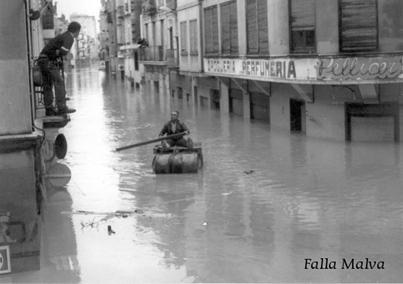
This link contains a photographic reportage of "Pantana" (the name by which is called this flood in Valencia realized by the falla plaza Malva  from Alcira (www.fallamalva.com)


picture of the flood, taken from the above link

BREAK OF THE TOUS DAM October 20, 1982 (Part 1)

On October 20, 1982, as a result of torrential rains caused by the cold drop, originated the worst flood in the history of Spain. Affecting Jucar basin that were more intense in the Valencia and Murcia.


On the night of 19 October, heavy rains began extending along the next day exceeding 600mm. Upstream Tous Swamp.
The river Jucar (Xuquer in Valencia, that comes from Arabic and its translation is the devastating) as it passes through the swamp of Tous, grew so that the weak walls and the lack of qualified personnel to hazardous situations in the dam joined inability to open the floodgates (because of the human factor) caused water to overflow the dam, and even when they got to open the floodgates, the amount of water was greater than the capacity of these. So finally broke down the dam. Causing a flood of 16,000 cubic meters per second, which devastated the regions of the Riera Alta and Riera Baja.


The populations most immediate to the dam came to have in their streets 8 meters high of water, such as Sumacàrcer, Beneixida or Gavarda.
The virulence of the water caused severe structural damage to most buildings, that's why Beneixida and Gavarda moved to higher ground, but Sumacàrcer remains in the same place.


This link contains a photographic reportage of "Pantana" (the name by which is called this flood in Valencia realized by the falla Plaza Malva from Alcira  (www.fallamalva.com)


picture of the flood, taken from the link above

30th ANNIVERSARY OF THE BROKEN OF THE TOUS DAM


Today October 20 marks the 30th anniversary of the breaking of the Tous dam, located in the region of the Riera Alta in the province of Valencia.
Suffering the worst flood in Spain.
Because of heavy rains due to the cold drop of 1982, the Tous dam (located between the towns of Tous and Millares) grew up to never known limits, exceeding the capacity of the dam and the responsible engineer.
Finally the dam gave way, flooding the whole region of the Riera Alta with maximum heights of 8 meters of water in the streets of some towns.


The old dam with a capacity of 80 cubic hectometers, could not withstand the pressure of the river Jucar (Xuquer in Valencian, name given by the Arabs who inhabited the Valencian Community, which translates as the devastating).
After the flood the dam was rebuilt with a current capacity of 340.4 cubic hectometers, modern sensors and with caution to reach these dates with minimum water.

This link contains a photographic reportage of "Pantana" (the name by which is called this flood in Valencia made ​​by the falla plaza Malva  from Alcira (www.fallamalva.com)


flood photo, taken from the Above link

viernes, 19 de octubre de 2012

CITY OF ARTS & CIENCE (history part 2)

In May 1991 the Consell approves the transfer of land, four months after Calatrava presented his draft and later that year, was created a company to manage public works that began in late 1994.


With the works awarded and the foundations of the towers built, the PP (Partido Popular) and paralyzes access to government works, for wanting to redesign the project to give a "different philosophy" after months of controversy, is canceled but the Radiocommunication Tower preserving the other two buildings from Calatrava (Museum of Science and l'Hemisferic), adding l'Oceanografic (oceanographic park) and substituting the socialist icon of the Tower, by an Opera (Palace of Arts).
Calatrava redesign the project including the Palau de les Arts.

The Spanish-Mexican Felix Candela (one of the masters from Calatrava), Developes  L'Oceanografic.
After two years from l'stops at the l'Oceanografic, the works were completed by engineers Alberto Domingo and Carlos Lázaro (responsible for the cover from L'Oceanografic underwater restaurant.


The Palau de les Arts, lost its condition of Valencian Cinematheque for the Opera.

Subsequently added to the project two bridges, and the Agora Building.


aerial view of the city of arts and sciences, taken from Wikipedia

CITY OF ARTS & CIENCE (history part 1)


The City of Arts and Sciences, is a cultural and architectural complex located in the old riverbed of Turia in Valencia.
Designed by Valencian architect Santiago Calatrava of international prestige and Felix Candela.
On 16 April 1998 the complex was inaugurated by opening doors from the L'Hemisferic (eye-shaped building, which contains a 3D cinema and planetarium), followed in time the other buildings until the inauguration of the Agora the October 31, 2009.


Today it is one of the biggest attractions of the city.

In 2007 it was one of the winners of the National Treasury organized by Cadena COPE (Spanish radio station) and Antena 3 (national television).

The original project began in 1989 when the professor of history at the University of Valencia José Maria López Piñeiro, raised the need for a science museum in the old riverbed of Turia. The then President of the Generalitat Valenciana (Valencian government) Joan Lerma (from Spanish Socialist Party PSOE) request to create a team to develop a project with educational purpose. That revolved around a half complex cultural, tourist half.

2 years after a project was presented under the name City of Science, which would include a telecommunications tower height of 370 meters (would have been the third highest in the world at that time), a planetarium and a science museum, estimated at 150 million Euros.


picture of the view of the City of Arts & Cience from the Miguelete, taken from the Wikipedia

TENNIS VALENCIA OPEN 500 (hystory)


The ATP tennis tournament in Valencia, was first held in 1995 (the 1996-97 moved to Marbella, and was held in Mallorca from 1998 to 2002), until 2008 its category was of ATP International Series and was played in clay at the Valencia Tennis Club ..
By restructuring the schedule in 2009 became ATP Open  500 and change to hard court be performing at The Agora in Valencia (in the City of Arts and Sciences).

A distinguishing feature of the Valencia Open 500 is the creation of FUN PARK, a shopping, entertainment and dining free entry to all the public (usually an area generally accessible only to those who have entry), located in the enclosure of the city ​​of Arts and Sciences.


Picture from the Valencia Open 500 in the Ägora building taken from Wikipedia